Xandar Kardian (Reassurance Solutions / XK-300)
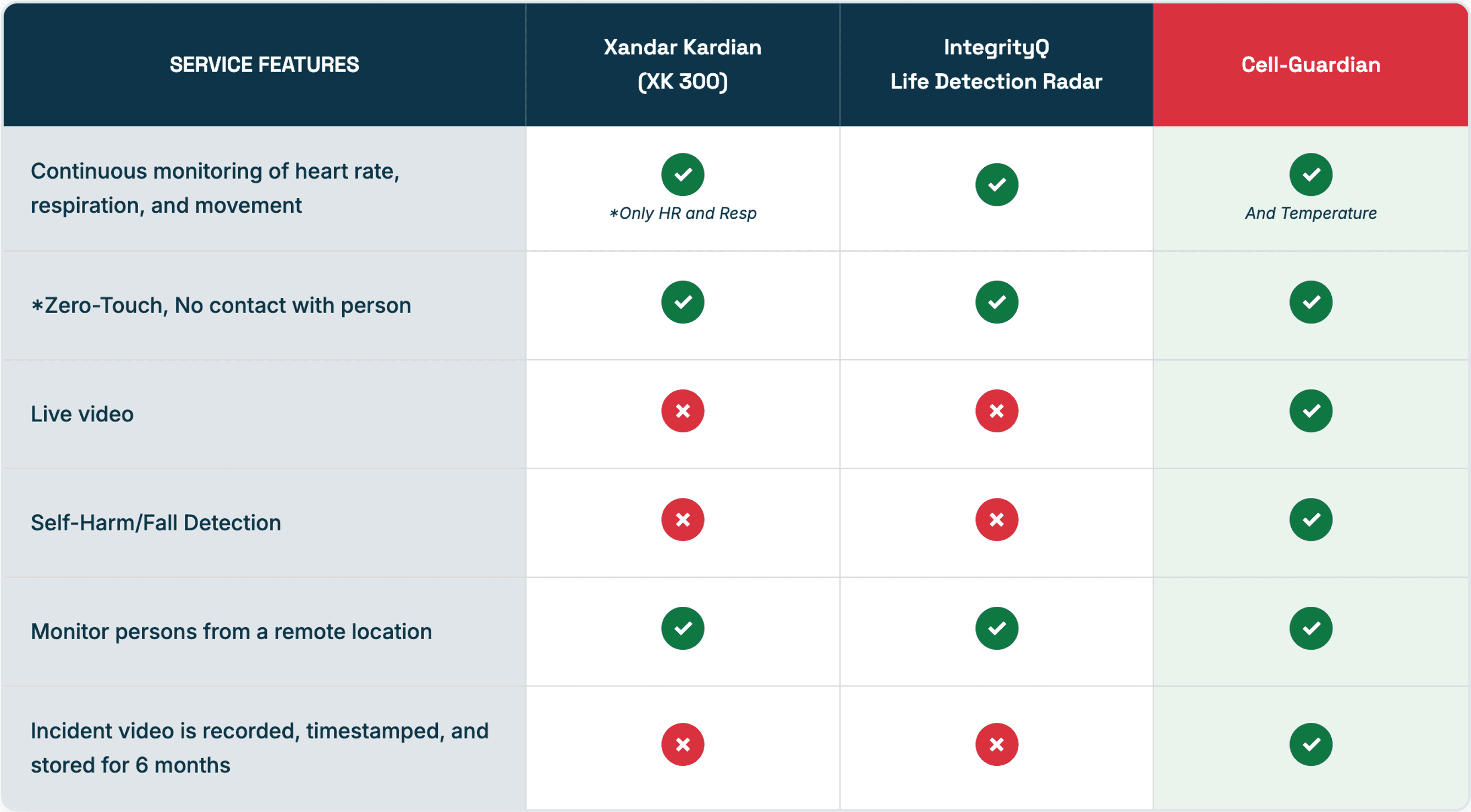
Technology: This is a single-sensor system that uses UWB radar to remotely detect micro-vibrations for life-sign monitoring. It only monitors Heart Rate and Respiration.
Key Weaknesses:
No Fall Detection: Their system is not designed to detect falls, a critical event in at-risk populations.
No Visual Verification: There is no integrated camera to visually confirm why an alarm was triggered, forcing officers to enter the cell for every alert, regardless of its nature.
No Incident Recording: Does not record, timestamp, and store incident video for legal and operational review.
Limited Environmental Monitoring: The system does not monitor for ambient temperature.
Prone to False Alarms: Because it only tracks one data point (vibration), it can be triggered by simple movements like coughing or adjusting a blanket, leading to "Orange Alerts" and significant alarm fatigue for staff.
Integrity Q Sensor / Integrity Communications (AiRC)
Technology: They position their product as a radar and camera solution for measuring "human behavior with millimeter precision."
Key Weaknesses:
Not Purpose-Built for Corrections: Their marketing focuses broadly on industrial and human behavior monitoring, not specifically on the critical life-saving applications required in corrections (like vital signs or fall detection).
No Self-Harm/Fall Detection: The system is not designed to identify these critical events.
No Live Video or Incident Recording: Lacks the crucial ability to provide a live feed or store time-stamped video evidence of incidents.
Unproven AI Claims: Their focus is on movement tracking, not interpreting distress signals like a lack of breathing or a medical emergency. There is no evidence their system can detect a medical emergency.
Limited Market Presence: They are a smaller player with very little public information or case studies available regarding their use in correctional facilities.